
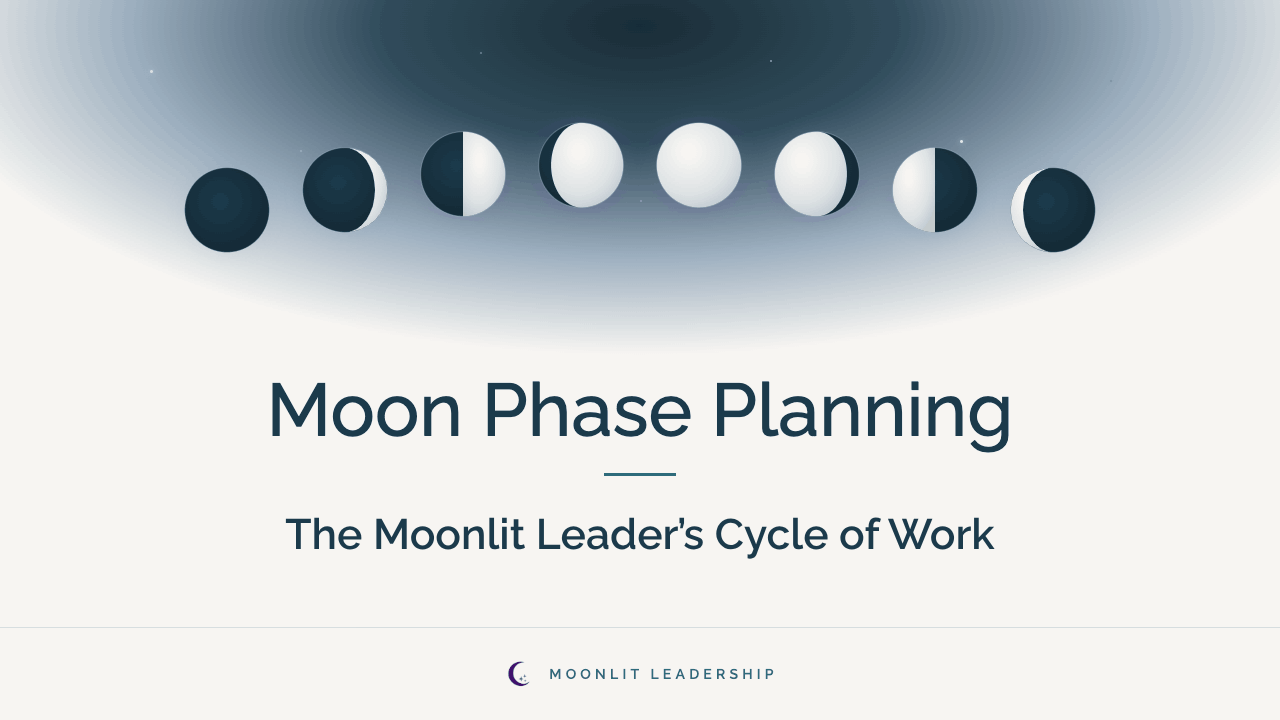
Moon Phase Planning maps a Moonlit Leader’s work onto the eight phases of the moon, each a different mode of work and a different level of visibility. Naming the phase you are in helps you match your effort to the moment and make the quieter work legible to the people around you.


Introduction | New Moon: Reception | Waxing Crescent: Commitment | First Quarter: Friction | Waxing Gibbous: Refinement | Full Moon: Visibility | Waning Gibbous: Transfer | Last Quarter: Release | Waning Crescent: Integration | Eclipse Overrides
Introduction
Every initiative you run moves through the same familiar steps. Discovery, design, build, launch, and the retrospective that never gets enough calendar. Your own work moves through phases too, the way the moon does, and most weeks you are in several of those phases at once.
The steps you already know
Every initiative in a company runs through the same set of steps, and you know them by heart. Discovery, then design, then build, then launch, then the retrospective if the team makes time for it. The steps are consecutive. Each one finishes before the next begins, and each hands its output to the one that follows. The whole sequence points at a single destination, a finished thing shipped out the door. Progress is the measure. An initiative stuck in discovery for a year is an initiative in trouble, and everyone in the room knows it.
The model works. It tracks the work and moves measurable work forward, which is exactly what a delivery plan is for. What it measures is the project, its position and its distance from done. The person carrying the project moves through a different cycle, one that runs in a loop rather than a line.
Your work has phases too
The moon completes one full cycle every 29.5 days, moving through eight phases: New Moon, Waxing Crescent, First Quarter, Waxing Gibbous, Full Moon, Waning Gibbous, Last Quarter, and Waning Crescent, then back to New Moon. The phases are not the moon changing shape. The sun lights exactly half the moon at all times. What shifts is the angle, the moon’s position relative to the sun and the earth. The moon is always whole. What changes is how much of it anyone on the ground can see.
A Moonlit Leader’s work moves the same way. It cycles through eight working phases that mirror the moon’s, from the dark of New Moon, where the work is all sensing, out into full light and back to the dark again, then starting over. Those eight phases track your relationship to the work: how visible your contribution is at a given moment, and what kind of work the moment is asking for.
Put that next to a workstream and the two come apart. A project can sit squarely in build on the roadmap while the leader carrying it is in New Moon, running the quiet off-the-record conversations that decide whether build survives contact with reality. Another project can be at launch while its leader has already moved into reception, sensing the next problem before anyone has named it. The roadmap tracks the project. The phase tracks you.
Each moon phase names a mode of moonlit work. New Moon is Reception, the taking in. Waxing Crescent is Commitment, the quiet alignment. First Quarter is Friction, the hard push. Waxing Gibbous is Refinement, the prevention work. Full Moon is Visibility, the work seen. Waning Gibbous is Transfer, the handing off. Last Quarter is Release, the clean close. Waning Crescent is Integration, the rest and absorption.
One caution, because the pull toward a neat mapping is strong. The two cycles seem to invite it, New Moon lined up with discovery, Full Moon lined up with launch. Resist it. They run on different axes, and forcing one onto the other collapses the whole idea back into a checklist. Reception can happen at launch. Visibility can land in the middle of build.
One week, three phases at once
Because the phase tracks your relationship to each workstream, and you are carrying more than one, you are usually standing in several phases at the same time.
Picture a Chief of Staff in a single ordinary week. The board offsite is at Full Moon. She is on stage, the work is visible, months of preparation are finally in the light and the room can see it. The quiet reorg is at New Moon. Only a handful of people know it is happening, and her work there is all sensing and off-the-record conversation. The budget fight is at First Quarter, pure friction, pushing a hard call through resistance that would rather it went away. Same leader. Same week. Three phases, all live at once.
That week is what the job looks like. The skill is naming which cycle you are in on which workstream, and giving each the mode of work it needs. Full Moon energy poured onto a New Moon problem is wasted. New Moon patience applied to a First Quarter fight is a missed escalation. The performance system that reads the week as inconsistency is holding up the wrong instrument. The sun is either up or down. The moon knows how to be full, how to be invisible, and how to hold every state in between.
What follows
What follows moves through all eight phases in order, from New Moon to Waning Crescent, each one a different mode of work and the case to make for it when it goes unseen. After the cycle come the eclipse overrides, the events that suspend the phases entirely and rewrite the rules for as long as they last.
New Moon: Reception


The cycle begins in the dark. Reception is the phase of taking in, the deep attention a Moonlit Leader does before there is anything to show for it.
New Moon sits between the sun and the earth, its lit face turned away. From the ground there is only dark sky. The moon is entirely there, holding its place, pulling the tide, reflecting no light we can catch. This is where the cycle starts, and where the Moonlit Leader starts too, absorbing before anyone has asked for output.
In the work
The work of reception is attention, done early and done quietly. A Clinical Operations Lead, weeks into a new Chief Medical Officer’s tenure, is having the off-the-record conversations about what is actually happening on the wards, the version that never reaches the dashboard. She is mapping the ground, learning it well enough to know what will need fixing before anyone has named a problem.
A Legislative Director, the morning after an election shifts the balance of a committee, is reading the new political climate. Which alliances dissolved overnight, which coalitions are forming before the caucus convenes. The memo she writes in three weeks depends entirely on what she takes in now, while it still looks like she is doing nothing.
The misread
From the outside, reception may look like idleness. The Moonlit Leader is present but not producing, and the performance system, calibrated to count output, sees nothing to count. This is the phase most likely to be read as disengagement, and it is the phase that decides whether everything after it lands. The absorbing is the work. It leaves no visible trace until later.
Make the case
This is where the Moonlit Leader steps in. When the quiet is getting read as idleness, make the case for what it is producing, in language that does not require the framework:
“I’m in the sensing phase right now, reading the ground before I bring recommendations. The picture I build in the quiet is what makes the next call fast.”
Make it early in a change, when there are questions and not yet answers, and someone above is wondering why you have gone quiet. The case is the work made legible. It gives the room something to credit before the results arrive.
The dark moon is still whole, still pulling the tide. Reception is the work no one can see yet.
Waxing Crescent: Commitment


The first light after the dark. Commitment is the phase of quiet alignment, the coalition a Moonlit Leader builds before the work is ready to be seen.
Waxing Crescent is the first light of the cycle, a thin curved sliver catching the sun low in the western sky just after sunset. Most of its face is still in shadow, only that bright edge showing. The lit part is small, but it is growing, the moon turning toward full. This is where the Moonlit Leader works in the early light, building quietly the alignment the work will stand on before anyone is watching.
In the work
The work of commitment happens below the surface, deliberate and mostly unseen. An Executive Assistant, ahead of a leadership change the CEO has not yet announced, is having a separate conversation with each member of the leadership team. Not scheduling, listening. Testing where the resistance will come and what shape it will take, so that when the CEO finally walks into the room, the ground has already been prepared.
A Program Manager, weeks before a program review that will expose the gaps, is quietly reallocating resources and resetting timelines. She is building the scaffolding that will hold the weight of what is coming, gathering the commitments now, so the review finds a plan in place instead of a problem to solve.
The misread
From the outside, commitment looks like networking. Sidebar conversations, coffees, quiet check-ins, and no output anyone can point to. The calendar fills with meetings that produce no document and no deliverable. It reads as socializing, or as circling the real work. The alignment being built in those conversations is what decides whether the visible work later holds or falls apart.
Make the case
This is where the Moonlit Leader steps in. When the sidebar work is getting read as mere networking, make the case for what it is securing, in language that does not require the framework:
“I’m lining up the alignment we’ll need before we move. When we bring this forward, the key people are already with us, and it moves instead of stalling.”
Make it when your calendar is full of conversations and empty of deliverables, and someone is wondering why you have not shipped anything yet. The case turns quiet coalition work into something the room can count as progress.
The sliver is thin, but the light is growing, and the moon is already pulling what comes next into place. Commitment is the alignment built before anyone is watching.
First Quarter: Friction


Half in light, half in shadow. Friction is the phase of pushing a hard call through resistance, the point where the Moonlit Leader meets the wall the earlier phases could not remove.
First Quarter is the moon at its most divided, one half lit and one half dark, the two meeting in a hard straight line down the middle. It stands high in the evening sky, bright on one side and black on the other with no blur between them. The moon is caught exactly halfway, between dark and full. This is where the Moonlit Leader meets resistance head on, holding a hard call in place against everything pushing to drop it.
In the work
The work of this phase is force applied against something that pushes back. A Chief of Staff, midway through a reorganization the executive team agreed to in principle and now resists in practice, is holding the line on a decision that has become inconvenient. The alignment built earlier is being tested, and holding it takes daily pressure, the same argument made again to people who hoped it had gone away.
A Development Director, weeks before a capital campaign goes public, is forcing a hard conversation about a naming gift the board wants and the mission cannot afford. She is the friction in the room, slowing a decision everyone else wants to rush, because the fast version creates a problem the organization will carry for years.
The misread
From the outside, friction looks like obstruction. The Moonlit Leader is the one slowing things down, reopening settled questions, making the meeting harder than it needed to be. In a culture that prizes speed and agreement, the person creating drag reads as the problem. The resistance being applied is often the only thing keeping a bad call from sailing through unchallenged.
Make the case
This is where the Moonlit Leader steps in. When holding the line is getting read as obstruction, make the case for what the friction is protecting, in language that does not require the framework:
“I’m slowing this one on purpose. The version we rush now is the version we pay for later, and I would rather take the friction here than the cleanup after.”
Make it when you are the one voice holding a decision open and the room wants to move on. The case reframes the drag as protection, and gives people a reason to sit in the discomfort a little longer.
The line down the middle is sharp, light meeting dark with no blur between them. Friction is the phase where the work is decided by who holds.
Waxing Gibbous: Refinement


Almost full, the last shadow thinning. Refinement is the phase of catching problems before they surface, the prevention work a Moonlit Leader does that shows up as nothing going wrong.
Waxing Gibbous is the moon more than half lit and still filling out, a rounded shape with only a thin edge of shadow left. It climbs high and bright across the evening sky, close to whole but not yet there. The last dark sliver is thinning, the light almost complete. This is where the Moonlit Leader refines what the friction left standing, closing the final gaps before the work stands in full view.
In the work
The work of refinement is prevention, the unglamorous polishing that decides how well the visible thing holds. A Platform Reliability Lead, days before a launch that will multiply traffic tenfold, is running failure drills against systems that are working perfectly well right now. She is finding the weak points on purpose, hardening the paths that would buckle under load, so that on launch day nothing happens at all.
An Events Director, in the final week before a thousand-person conference, is building the contingencies no attendee will ever know were needed. A backup venue for the keynote, a second caterer on standby, a plan for the speaker who might cancel the night before. If she does the job well, the day feels effortless, and all that preparation disappears into the ease of it.
The misread
When refinement works, nothing happens, and nothing is a hard thing to point to. The launch that did not crash, the event that ran clean, they get read as easy, or as luck, or as a job that must not have been very hard. The calm is the product of the work, and it is exactly the calm that hides it. Success in this phase erases its own evidence.
Make the case
This is where the Moonlit Leader steps in. When smooth execution is getting read as luck or ease, make the case for the work that produced it, in language that does not require the framework:
“The reason nothing broke is that I spent the last month finding everything that could. The calm you are seeing is the work, done early.”
Make it right after a launch that went well or an event that ran clean, while the effort is still fresh enough to name before it vanishes into the result. The case pulls the prevention work back into view before the room forgets it was ever at risk.
The moon is nearly whole now, the last shadow almost gone. Refinement is the work that shows up as nothing going wrong.
Full Moon: Visibility


The moon at its fullest, and the light it gives is the sun’s, caught and returned. Visibility is the phase where the work is finally seen, and the risk shifts from being missed to being read as something that happened on its own.
Full Moon is the whole lit face turned toward us, round and bright enough to read by, with the earth now between it and the sun. It rises as the sun sets and holds the sky through the night. Every bit of that light is the sun’s, caught and given back. This is where the Moonlit Leader’s work finally stands in full view, seen at last, and where the risk shifts from being missed to being read as something that happened on its own.
In the work
The work of this phase is standing in the result, at the moment it becomes visible to everyone. A Communications Director watches the CEO deliver the announcement she spent six weeks shaping, the message, the sequencing, the answers to the questions the room has not asked yet. The launch lands and the coverage is strong. In the retelling, it becomes the CEO’s announcement, and the architecture underneath it goes unnamed.
A Head of People stands at the back of an all-hands as three teams are recognized for a milestone. She designed the entire moment, the framing, the order of who speaks, what the room feels as it ends. The teams get their applause, which is the point. The design that made the applause land dissolves into the ease of it.
The misread
Here the misread flips. For four phases the work was invisible and got read as too little. Now the work is visible, and it is the orchestration behind it that stays hidden. The result gets celebrated, and the coordination that produced it reads as something that simply came together. Being seen and being credited are different things, and full visibility of the outcome can leave the author of it more invisible than before.
Make the case
This is where the Moonlit Leader steps in. When the result is getting celebrated and the orchestration behind it is going unnamed, make the case for how it came together, in language that does not require the framework:
“This did not come together on its own. A month ago three teams were pulling in different directions, and the work of aligning them is why today looks easy. Worth naming, so we can do it again.”
Make it in the moment of the win, while the result is fresh and the room is receptive. The aim is to make the pattern legible, so a one-time success becomes a capability the organization can recognize and repeat.
The full moon is bright, and every bit of that light is the sun’s, caught and given back. Visibility is the phase where the work is seen, and the orchestration behind it still has to be named.
Waning Gibbous: Transfer


The light begins to recede. Transfer is the phase of handing off, the mentoring and documenting a Moonlit Leader does to make the work outlast the moment.
Waning Gibbous is the moon still mostly lit but no longer whole, the shadow now returning along one edge. It rises later, well after dark, and lingers into the morning. The light is past its peak and beginning to draw back. This is where the Moonlit Leader turns from standing in the result to handing it on, giving away what the earlier phases built.
In the work
The work of transfer is moving what you know out of your own head and into other people. A Product Operations Lead, a month after the launch that consumed her spring, is turning the process she improvised under pressure into a written runbook and training the two colleagues who will own it. She is making herself unnecessary to it on purpose, so the thing keeps running when her attention moves elsewhere.
A Department Chair, rotating out at the end of the term, is spending her last weeks walking the incoming chair through what lives nowhere on paper. Which promises were made to whom, which alliances hold and which are fragile, why a settled-looking arrangement is actually load-bearing. The institutional memory is in her, and she is spending down her remaining time moving it into someone else before it leaves with her.
The misread
From the outside, transfer looks like winding down. The urgent work is finished, the result is shipped, and the hours now spent documenting and mentoring read as optional, the soft part you do once the real work is over. It is the phase least likely to be protected on a calendar and the first to be cut when the next fire starts. The knowledge being handed off is the only thing that keeps the win from walking out the door with the person who produced it.
Make the case
This is where the Moonlit Leader steps in. When the handoff work is getting read as winding down, make the case for what it secures, in language that does not require the framework:
“I’m moving what I know into the team while it’s fresh. If I skip this, the next person rebuilds it from scratch, and we pay for the same work twice.”
Make it when the result is shipped and someone is wondering why you are still on it instead of the next thing. The case reframes the handoff as the line between a one-time win and a capability the team keeps.
The light is drawing back now, the moon giving away what it held at full. Transfer is the work of making yourself unnecessary.
Last Quarter: Release


Half-lit again, now on the way down. Release is the phase of letting go, the honest accounting and clean close a Moonlit Leader does before the next cycle can begin.
Last Quarter is the moon half lit again, the mirror of First Quarter with the opposite side now in light. It rises late and hangs in the morning sky, a pale moon fading against the daylight. The light is halfway back toward dark, the cycle nearly closed. This is where the Moonlit Leader stops to account for what the cycle produced, letting go of what does not carry forward.
In the work
The work of release is the honest look back and the clean ending. A Portfolio Director, the week after a major program closes, is running the retrospective that names what actually happened, the decisions that worked, the one that cost three months, the assumption that never held. She is writing down the expensive lessons while they still sting enough to be true, so the next program does not buy them again.
A Restructuring Lead, at the end of a wind-down, is closing out what remains, the vendor contracts, the final accounting, the last conversations with people whose roles are ending. She is making sure the thing ends cleanly rather than trailing loose ends someone trips over a year later. The ending is the deliverable, and she is the one making it a real one.
The misread
From the outside, release looks like dwelling. The work is done, the outcome is known, and time spent looking backward reads as slow, or morbid, or a reluctance to move on to what is next. In a culture pointed always at the next thing, the retrospective is the meeting that gets skipped and the clean close is the step that gets rushed. The accounting done here is what turns a finished project into a lesson the organization actually keeps.
Make the case
This is where the Moonlit Leader steps in. When the look back is getting read as dwelling, make the case for what the ending secures, in language that does not require the framework:
“I’m closing this one out properly before we move. Ten minutes of honest accounting now saves us from repeating the costly parts next quarter.”
Make it when the result is in and the room wants to sprint to what is next. The case reframes the close as an investment in the next cycle rather than a delay on this one.
The half-lit moon is fading toward the dark, the cycle almost back where it began. Release is the work of ending a thing well enough that the next thing starts clean.
Waning Crescent: Integration


The last light before the dark. Integration is the phase of rest and absorption, the quiet a Moonlit Leader needs before the next cycle can begin.
Waning Crescent is the last thin sliver of light, a fine curve low in the eastern sky just before dawn. It thins a little more each morning, sliding toward dark. Soon it will be new again, the cycle back at its beginning. This is where the Moonlit Leader slows before the turn, resting and letting the finished cycle settle into something learned before the dark asks for everything again.
In the work
The work of integration is quiet, and much of it does not look like work at all. A Chief of Staff, in the lull after a board cycle closes, is not starting the next thing yet. She is letting the last one settle, noticing what she would do differently, allowing the pattern to sink from something she did into something she knows. The next New Moon will ask her to sense again, and she will read the ground faster for having paused here.
A Field Operations Director, home after a season of back-to-back deployments, is deliberately doing less. Recovering the capacity the next season will demand, letting the team catch its breath, resisting the pull to fill the quiet with motion. She knows the rest is what makes the next push possible, and that a team run straight from one cycle into the next arrives at the new one already spent.
The misread
From the outside, integration looks like nothing. No output, no visible motion, a leader who appears to have stopped. In a culture that measures worth by activity, the pause reads as coasting, or as a gap to be filled with the next assignment. The rest and absorption happening here is what lets the next cycle begin from strength instead of depletion. Skip it, and the new New Moon starts already tired.
Make the case
This is where the Moonlit Leader steps in. When the pause is getting read as coasting, make the case for what it restores, in language that does not require the framework:
“I’m letting the last cycle settle and recovering before the next one. The team that rests now is the team that moves fast when the next thing lands.”
Make it when the work is done and someone is already asking what you are picking up next. The case reframes the pause as preparation, the quiet that the next cycle is built on.
The last sliver thins toward dark, and the dark is where it all begins again. Integration is the rest that lets the cycle turn.
Eclipse Overrides


Sometimes the cycle breaks. An eclipse overrides the phase you are in, and the normal guidance is suspended for as long as it lasts. There are two, and they fall at opposite points of the cycle. One at New Moon, one at Full Moon. They are opposite events, and each asks for the opposite of what your instinct will tell you to do.
The solar eclipse
A solar eclipse falls at New Moon. The moon passes between the sun and the earth, and for a few minutes the moon covers the sun and the corona appears, the ring of light that was always there but could never be seen while the sun was at full strength.
In the work, this is the moment the executive disappears and you step into the gap:
• A CEO goes on medical leave
• A sudden departure
• A founder crisis
You step between the source and the organization, and the corona is revealed, the organizational truths that were never visible while the executive’s brightness was at full power. Power dynamics surface. Structural gaps become undeniable. The real operating rhythm of the place shows its true shape.
The instinct is to plant something of your own. To launch your initiative, to claim the authority, to reshape the organization toward your vision while the light is briefly yours. The eclipse protocol runs the other way. Hold the position with reverence. Reveal without claiming. The solar eclipse is revelatory. Its job is to make the hidden visible. Trust that the alignment is temporary, as every eclipse is, and that the executive’s light returns.
The lunar eclipse
A lunar eclipse falls at Full Moon. The earth passes between the sun and the moon, and the earth’s shadow falls across the moon at the exact moment it should be at its brightest. The moon does not go dark. It turns blood-red, its light distorted, not extinguished.
In the work, this is the moment the organization blocks your light at peak visibility:
• A reorg removes your sponsor
• A political shift redirects the credit
• The audience that was meant to see your work is looking elsewhere
Your reflected light turns red, still there but changed by the shadow the organization has cast. The work is real. The contribution is real. What the room sees has been distorted by forces that have nothing to do with the quality of what you did.
The instinct is to fight through. To assert the visibility, to insist on the credit, to push the launch through the obstruction. The eclipse protocol runs the other way. Release the deliverable. Protect the relationships that matter. Do the shadow work of understanding what created this eclipse. Metabolize before you move.
Both eclipses are temporary. The shadow moves on, and the light returns. Two eclipses, opposite responses. Release the lunar. Reveal the solar.
Moonlit Leadership is a body of work for the leaders who make organizations actually function. The industry may have skipped them. We have not. More at moonlitleadership.com.
✦ ✦ ✦
About the Author
Angela Segovia has spent nearly two decades in leadership roles spanning Chief of Staff, commercial strategy, product strategy, and program and portfolio leadership in global gaming, technology, and educational technology. Before that, she was a librarian. She is the creator of the Moonlit Leadership framework and writes regularly at moonlitleadership.com and on LinkedIn.
Leave a Reply